


Thrown for a to the wolves.
I’ve always been fond of the phrase “loop the lupine.” —As I recall(ed), I’d first seen it in a blurb on the cover of a Gene Wolfe paperback: “Gene Wolfe is the master of loop-the-lupine writing,” or some such, from Philip José Farmer, I was pretty sure. It caught my eye, and my imagination, as you might expect of someone so drawn to the practice of talking outside the glass.
Some time ago, I tried to nail down the origin of the phrase—none of the Gene Wolfe books in the house were thusly blurbed, not Castleview or any of the Severians, or the Suns of various shapes, not The Island of Doctor Death and Other Stories and Other Stories, not Free Live Free or Peace, and so I turned to Google, which was better then than it is now, but still: I couldn’t find the actual origin of the phrase. Just a handful of quotes, and echoes, enough to somehow leave me with the notion that it was maybe coined by Algis Budrys, in one of his review columns for F&SF, that, yes, may well have been mined for a blurb, and thus, and so—but, though this was some (considerable) time after, it was still quite some time ago, and I didn’t, at the time, bother to take any notes, or bookmark any finds, and so here and now I couldn’t tell you what it was that led me to that notion, or why.
Just recently, I was seized for whatever reason by the urge to dig into the lupine loop again, to see if I couldn’t this time nail down the circumstances of its coinage. I mean, it’s an evocative phrase. Somebody else might’ve noticed. So off I went to Google again (DuckDuckGo, for all its advantages, yet lacks some critical juice; it turns up no results for the phrase), and Google came back with, well, just one (1) hit, out of all the billions of pages out there: an entry in a Wolfe wiki that features the phrase “loop-the-lupine loop sense of things,” an obvious allusion that nonetheless misses the point in overly elaborating it. —I tried the same search in Google Books (which, yes, you’d expect would appear with the others when you’ve asked it for all results, but often for whatever reason just don’t), and got another lone hit: the same malappropriate phrase, “loop-the-lupine loop,” in a somewhat different context.
And that was it.
Which is maddening, for a number of reasons—websits dissipate, disappear, are deleted every day from the Akashic record, and thus our various search engines—but, I mean, that phrase, “loop the lupine,” it’s here, on the pier, and should ought to have also come up in the results. —Google, it must be said, in this benighted age, now frequently returns additional new and different results as you add search terms to your query—an entirely counterintuitive means of refining one’s searches, but here we are. So I added “budrys” to my search—and there I was—but also, Google offered up, well, this:
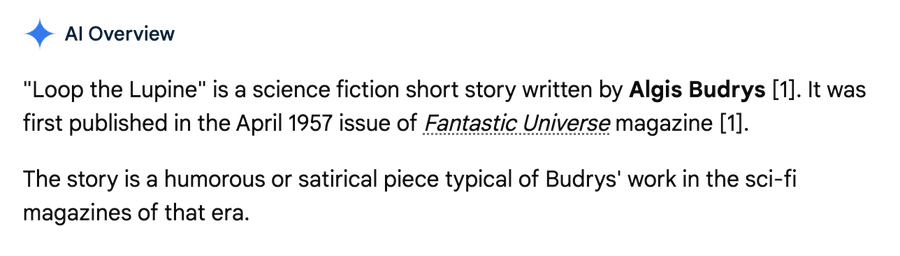
Which, I mean: no.
—I should note these searches were performed on my usual home browser, which is never logged in to Google in any capacity. (Fruitless, I know, but a man’s got to have a code.) At the office I’ve got a browser logged in to Google, for office reasons, and so on a break, I tried that initial search again, “loop the lupine”—
And got eight (8!) hits: my site, and the Wolfe wiki, as well as a smattering of fortuitous phrase- and sentence-breaks (“include the Lower Loop, the Lupine trails”; “then over the collar loop. The Lupine, you just hold the snap”; and another one, about, well, lupins)—and, and! These two additional hits: one for a copy of (aha!) There Are Doors, which quotes the various blurbs in its copy, and one for (oho!) the Official Philip José Farmer Web Page, listing blurbs he’d given throughout his career, including the one I’d obviously remembered from oh so long ago:
THERE ARE DOORS is another splendid example of what I call the Loop-the-Lupine school of writing. Gene Wolfe is its originator and sole practitioner. His works are always singular and brilliant, the rare kind you read until you’re at the end, everything else going to hell while you read.
So here we are, and you’d think I’d be happy, to’ve finally run this down, to be vindicated, even, so many years later. Instead, I’m dispirited, I’m evervated, I’m mildly appalled, even—it’s one thing to sigh along with your morning reading of the latest enshittification tirade, to nod along with a chorus of Google sucks!; it’s another entirely to have your face rubbed quite so thoroughly in the fact of it. —I tried the search once more when I got home; there, and then, that evening, it returned zero results. None whatsoever. Not a webpage in the whole wide indexed world to be found, where someone had entered those lexemes in that particular order, “loop the lupine,” despite what had been found at the office, despite what had been found that very morning with this selfsame browser, despite what I know to be true.
All I’ve got left is something akin to the bewildered tone in Samuel L. Jackson’s voice when he says to Robert De Niro, “Your ass used to be beautiful.”
(Since then, results for the search have settled down both at home and the office to the same basic nine [9] results, which now also includes another indirect reference to the blurb itself, from the archive of a thirty-year-old Long Sun mailing list. —Which is somehow even more pathetically unsettling.)



The one-armed man walks into a flower shop and says:
It is, as noted by Benjanun with characteristic acerbity, a “silly vacuous article,” but even the silly and the vacuous can lead you down productive paths, I mean, I ended up here, a translation of this, which is, yes, also silly? Closer to the metal, when it comes to discussing various and sundry aspects of this rather niche subculture, these male-identified individuals with an abdiding fondness for media focusing on intimate relationships between female characters, but there’s still a distancing breeziness, and also the distressingly extended metaphor of the carrier strike group. But! It’s the notion of a “yuri of absence” that is (yes) haunting me: “That is, an emotional scenery is already yuri… A cliff is towering over the sea, grass is growing on top of it, there is a fence, the gray ocean and sky are stretching beyond the horizon, there is an empty bench for two…” —And while there are (amusing) shades here of Nike’s (fictional, but) totalizing ad campaign of nothingness, I’m sure you can also see the problems that could well arise with this sort of disrepresentation? —And yet! Here’s yr. humble correspondent, a male-identifying individual with a fondness etc., who is in fact writing an epic that depends upon an intimate relationship between two women, and would you look for a moment at the æsthetic that underpins the cover images of the individual installments? So. Like I said. Haunted. —I need to dig up our notes on the rasa of yearning.
Always already brought back.
Oh, hey, it’s the 24th anniversary of this here blogging megillah. Favored gifts include opals, lavenders, and tanzanite, which, apparently, is the blue to purple variety of zoisite. —What went on last year? Let’s see: I tore up empathy, I wrote about what I’ve done with AI, I discovered some poetry from my grandfather, I didn’t so much like a very good book, and I was rather a bit more indulgent than, perhaps, usual. Let’s see what comes next.
The wandering I.
So yes I said I was going to re-read Zimiamvia, yes, but the thing about pulling the book off the shelf (it’s a big dam’ book) and assembling the supplemental texts and monographs and picking up a new notebook and finding the right pen is it all becomes, well, a Thing, and Things can be put off, and I anyway I also said, which I didn’t tell you, or at least not here, I said the other thing I might do would be to start pulling together my various disparate thoughts on cinematic prose into something of a defense if not a manifesto (I am not the sort for manifestoes, ask anyone), but the trouble with that is everything I’d have to say is prescriptively reasoned from principles I’m applying myself, which don’t end up describing anything but what it is I’m trying to do, which, I mean, seems more than a little indulgent—what I really ought to be doing is to survey the field, marshal some (other) examples, draw from them what it is this cinematic prose, this screen-like æsthetic, is doing, or trying to do, but there again, see, I’m assembling tasks and goals and texts to find and read and would you look at that, it’s also become a Thing.
And anyway, besides: a lot of the cinematic stuff downright sucks.
Which is maybe why some sort of defense, I mean certainly not a manifesto but maybe a set of some sort of proposed, I dunno, guidelines? considerations? alternatives? something, anyway, is perhaps, maybe, in order, to show a way to make it better, if it’s bad, or at least lay out some possibles that might be could be reified with some modicum of thought, but—but. That would entail pretending what it is I’m doing, or think I’m doing, is in any way better or more considered or grew from thoughts worth the thinking; would mean setting myself up however haphazardly as an expert, or at least an authority, which is unseemly; and now this Thing is rapidly becoming a Chore, and so we set it aside, I mean, I’m behind on the next novelette as it is, you know, the actual doing of the cinematic prose I’d be thinking of talking about instead. So! Zimiamvia it is.
Except.
I was clearing out old browser tabs, as one does, and fell into reading a Baffler take on the post-postmodern novel, as one does, and here, in this article I’d originally opened God knows how many months ago, about (in part) a novel I’m, and no offense or insult intended here, but I’m not at all likely to ever want to read, honest, it’s called UXA.GOV, which was apparently blurbed as “an unhinged occupation of the cinematic mechanism of Robbe-Grillet’s novels of the ’70s,” which novels the article goes on to describe as novels in which “tropes of cinema and genre fiction are playfully misappropriated as vehicles for Robbe-Grillet’s perverse preoccupations.” —And, I mean, I knew the name, Alain Robbe-Grillet: French, experimental, perverse, sadist, misogynist, that’s what’s jotted on his index card in my memory cabinet, in which he’s filed next to George Bataille (French, experimental, sadistic, perverse, and their names both end in disappearing consonants) who, because his most famous book or at least the title I can most readily bring to mind is Histoire de l’œil, the Story of the Eye, is filed next to that comic Jodorowsky wrote for Mœbius, the Eyes of the Cat (Chilean and French, perverse): thus, a glimpse of my personal filing system. —So! Here’s Robbe-Grillet, the French experimental sadist, and I’m being told his fiction, or at least what was written in and around the ’70s, is cinematic, and, well.
(If I’d been paying attention, I might’ve noticed him earlier—there he is, after all, in the introduction to Marco Bellardi’s Cinematic Mode in Fiction, mentioned with Hammet and Vittorini and Ballard as possible touchstones, but I was mildly dreading the approach of something called the “para-cinematic mode,” and skipped on by.)
Curiosity sparked, I went surfing, which is still possible, even in an enshittified age, and found, thank you, London Review of Books, here’s Robbe-Grillet railing against Balzac’s
omniscient, omnipresent narrator appearing everywhere at once, simultaneously seeing the outside and the inside of things, following both the movements of a face and the impulses of conscience, knowing the present, the past, and the future of every enterprise
and here he is, insisting on the primacy of the object, the material, the surface, denying even the possibility of depth:
The reader is therefore requested to see in it only the objects, actions, words and events which are described, without attempting to give them either more or less meaning than in his own life, or his own death.
But—but! Be careful: here he is with the rub of the green:
…no sooner does one describe an empty corridor than metaphysics comes rushing headlong into it.
The visible world is merely their skin. So I’m nodding along with the beat, here. —The point, for me, with the idea of cinematic prose or the screen æsthetic or whatever we’re going to end up calling it, cinematic, I think, it’s cooler, but anyway, the point has always been not so much to ape or mimic or reproduce this or that technique of cinema qua cinema in prose, to write a montage or a pan or a smash-cut: that can be done, sure, certainly, and is even a part of it, of course, but it’s not the point. The point is to take the limitations imposed and implied by the form of cinema and apply them as ground rules and organizing principles to prose—tennis, as more than one poet has noted, is no fun without a net. So:
- The point of view is at all times relentlessly focused on a specific here and a particular now: no speculating forward or ruminating backward, no pondering elsewhere, idly or otherwise.
- No conclusions are ever directly drawn. No inferences are explicitly made. Judgment is out of the question; metaphor and simile become unfortunate compromises.
- What is described is limited to what might be perceived by a camera, or a microphone. Anything else—touch, weight, temperature, smell or for God’s sake taste—they’re all too suggestive of a body, and thus of a subjective presence, and are to be avoided.
- Essentially, and crucially: there is no interiority, whatsoever. Interiority is the bunk.
What’s being evacuated, in the end, is any trace or notion of a narrator—which is patently absurd, of course: narratives must have narrators; tales must have tellers; what am I trying to hide? And where? —But there’s power in hiding, in cloaking, in what’s done where you can’t see: negative space is a vital component of any composition. I’m building empty corridors with the hope that you, dear reader, will fill them with metaphysics—but the shapes of those corridors can’t help but suggest and direct whatever ghosts you bring.
It’s not as if I set out to write like the cinema, or was impelled in that direction by a disdain for the smugly blinkered omniscience of so many third persons. The technique and the philosophy assembled themselves concurrently, as I was tinkering with stories and criticism way way back in the day on alt.sex.stories.d: something about pornography would seem to encourage a flatly objective approach, and a narrator to get out of the way. (For me, at least. Mileage varies, and all.) But at this much later point, I mean—this is how I write the epic, and the epic is what I write; I need to be able to say something entertaining if not intelligent about it, at salons, and cocktail parties; thus: technique, and philosophy.
Still: it was some kind of surprising to see arguments that I might very well have been making issue from the fifty-year-old pen of the soi-disant bad boy of French letters, a maître à penser of the nouveau roman whom, and no offense or insult intended here, but I’d never been all that interested in reading—it’s validating, sure, I suppose, but also disconcerting, what with the perversion and the sadism and the misogyny and the hebe- and pædophilia, and what with these arguments being made about and in service of the writing of his own infamously pornographic works. These are hardly new or unique or surprising arguments, but it’s still very much a this is the guy I’m standing next to? moment.
The library had copies of Project for a Revolution in New York and Recollections of the Golden Triangle, squarely within “the cinematic mechanism of Robbe-Grillet’s novels of the ’70s,” so I snagged them to have a look for myself, as one does. —Right off the bat, Project is a first-person text, and Recollections—well—features first-person narration; rather than being evacuated, the narrator’s right there, in the way, hectoring, chiding, speculating, inferring. What’s cinematic is more piecemeal, aping, mimicking, borrowing: a very visual approach, yes, as well as a cavalier abruption of transitions that tends to be noted, and commented upon, as it goes. (An earlier novel, Jealousy, seems ironically rather closer to my mark, with its deliberately if conspicuously absented narrator, but even here, dialogue’s condensed, summarized, subject to the judgment of someone supposedly not there.) —Project has an appealingly slippery beginning, and I very much enjoyed the energy of the opening of Recollections, but: and you can tell me all you like that the tortured women and girls are not women and girls but texts subjected to figurative mutilations, it’s all metaphor: and I wouldn’t want to dismiss him as little more than a dirty old man: still. The dirty old man bits are boring. —He’s excessive, yes, but very (sadly) conventional in his excesses; somewhere along my Robbe-Grillet surf I bumped into someone noting that his taste in lingerie is very Victoria’s Secret, which bon mot I’ve lost and can’t directly cite, apologies. His id is freed, sure, to set down whatever he might like from his subconscious, but none of it’s interrogated or investigated—merely indulged.
And it’s all a little too Screwfly out there right now to put up with any of that for whatever else might be on offer.
The only reference to any world outside of this setting is the description of a global economy whose elaborate rules and regulations, tariffs and taxes, aim at collecting wealth, either to maintain social status, or to support a corrupt state or government whose interest in money is rivaled only by its own complicity and participation in the perpetration of sexual torture. The socio-economic world of the book might not stand up to scrutiny as a model republic, but it does, overall, reflect Robbe-Grillet’s mistrust of laws, authority, and righteousness.
—the Translator’s Preface to
a Sentimental Novel
Speaking, then, of women in trouble—I noticed the other night that Lynch’s Dune had returned to Netflix, so I put it on as I was cooking (pasta with the simple kale sauce, I think); I like the rhythms of it, the soothingly whispered internal monologues, the charming hoke, Brad Dourif’s tightly hinged mentat, Big Ed drawling Stilgar’s stilt, and dang if those worms aren’t still somehow majestic. But this time I happened to look up from whatever it was I was doing (slicing ribs out of kale leaves, maybe, while the water built to a boil) as the leaving Caladan sequence began—
—and was struck by a couple of notions as it unreeled. The first, as the bizarrely mutated and poorly matted Guild Navigator floated up through spice-soaked light to fold space, and travel without moving, is that this time, I was immediately, almost painfully struck by how unutterably similar the moment is to a moment in Part 8 of the Return: the Giant, floated slowly up in a corner of the extra-dimensional movie theater, tilts supine as a glittering galaxy is spun about his head, and the golden pearl of Laura Palmer that he creates is doubled by the worlds the Navigator spits. —So utterly unexpected, so magically, shockingly beautiful, those painfully awkward forty-year-old special effects striving to depict something impossible, this electrifying connection with something so much sleeker, more assured, just as mystifyingly impossible. The hair stood up on the back of my neck; I went back to slicing kale.
The other notion, less disruptive, more germane: a moment earlier in the Dune clip—it’s all a bit stagey, elements almost collaged onto the screen, a planet, a moon, the great distant column of the heighliner, the gracefully orderly arcs of countless Atreides shuttles lofting slowly, stately toward it. Nothing looks or feels “real”—the lighting, the motion, the construction of the ships—but the effect is still somehow effective. It’s satisfying, in a way that meticulously worked out computer models with reams of lore behind every panel and strut to show us what it “really” would’ve looked like would not, could not, I mean I’ll step it back to might not, but that meticulousness and the working-out and the drive toward a “real” obviates the dreamlike meditativeness Lynch is striving for, that would short-circuit depiction and perception to reach straight instead for the experience, in all the many and varied senses of the word, the world, of something so unutterably impossible. —I found myself thinking of, of all things, Ladyhawke, and of how the transformations were not depicted, no, but suggested—shots of eyes, and feathers, a wing, spread, and the rising sun, which were all so much more effective, so much more satisfying, than the most “realistic” depiction of Michelle Pfeiffer morphing into a hawk could ever have managed to be.
An objective medium—cinema—reaching for subjectivity when its stock-in-trade fails. A subjective medium—prose—reaching for objectivity to force those moments when its stock-in-trade will fail. —In either case, in both cases, by frustrating expectations of what can or should or ought to be done, by leaving negative a space that positively should’ve been filled, the art, the expression, invites requests demands allows the reader, the viewer, the audience to step in, to fill in, to become the God of this or that particular gap, to assemble these subjective glimpses into a rendering of what it might’ve objectively been like, to shuffle these objective glimpses until the subjective meaning of them all becomes graspable if not clear.
Cinematic prose; prosaic (ha!) cinema. Anyway, that’s what I’ve been thinking of. How’ve you been?
No, when you’re in it, you’re in it. You believe in it, otherwise it’s just having fun, and I’m not interested in that.
Where were we.
Before we were so desultorily interrupted? Sorry to have left That Name pinned to the top of the pier for so long; let’s maybe look at it as sort of a metaphor for the bizarrely outsized impact his death and his works have had, even as his life and his work haven’t managed to break into the popular consciousness enough to even bother being forgotten. —I’ve been writing, of course I’ve been writing, writing the epic, and this was the year the third season got launched, which was a bit of work, but when that work is not going well, which it wasn’t, (which it isn’t, also, at the moment), then it tends to glower: the Scrivener window on that monitor over there, still waiting for its daily quota to be filled, it feels like an indulgence, typing up something else for somewhere else. (I really would rather it glowered when I’m off Blueskying, instead.)
—Let’s see, let’s see: I finally got to read the Elemental Logic books this year, which I adored: queerly grounded epickesque fantasy with the courage of its convictions to haul the story down some rather unexpected paths, and the way the magic is embodied in how the characters think is, well, magical. I’m late to this party, as I usually am, but it’s a good party, and there really ought to be more people here.
Then I went and read a Sudden Wild Magic, because Wm Henry Morris had to go and mention it on the aforementioned Bluesky: a really odd book, for one that’s so mildly, insistently normal: airy whimsy played po-faced for life-or-death stakes, and even the nice characters can be rather offhandedly brutally ruthless; I mentioned elsewere it felt like the first draft of the Bene Gesserit, but it also has the distinct air of a roman à clef of a writers’ group or circle or community, rather like How Much for Just the Planet.
Kelly Link’s Book of Love was—I mean, I didn’t not like it, there were beautiful sentences and loads of gorgeous moments but—altogether, it was somewhat ramshackle? Which is not the most perspicacious thing to say about the first novel written by an acknowledged master of the short story, I suppose, but there it is: Magic for Beginners, at less than a tenth the size, felt far larger and more epic.
I’m currently in the middle of Cecilia Holland’s only SF novel, Floating Worlds, which I could’ve sworn I’d read before, ages ago, but no, no; I think I’d started it, once or twice, but must not have gotten all that far, and somehow, dreamlike, it had merged with the memory of having read the Solarians in Venezuela at a very young age to make up the completed shape of a book on a shelf in the memory palace. —The Holland is much better than the Spinrad, though it’s dicey as hell on a couple of fronts; it hasn’t wrong-footed yet, and Paula Mendoza is up there on the list of favorite characters, so.
Next, I’ll probably be gearing up for a re-read of Eddison’s Zimiamvia books. Sean Guynes, as part of his ongoing essays on the Ballantine Adult Fantasy books, went and said some things about Zimiamvia that, I mean, it’s not that I think he’s wrong, or disagree on any pointed specific, but nonetheless my back was got up a bit: these are not dull and—well, all right, yes, there are patches that are rough going, but—but! these are not lifeless books. —There’s a lot of Eddison in the epic, and it’s specifically Zimiamvian Eddison: the Worm Ouroboros is great, and Lord Gro is also up there on the list of favorite characters, but I bounce off that book’s Boys Own Demon Lord protagonists, who never manage to catch me the way that Barganax and Lessingham have done, and Horius Parry, Fiorinda, yes, Antiope, even Anthea and Campaspe—toxic yuri avant le lettre. Among the prim and proper strait-laced taproots of what it is we hereabouts and now call “fantasy” (I mean, there they are, kicking off Lin Carter’s collection of Adult Fantasy books for Ballantine), these books are unexpectedly horny (but without the faux-courtly lookit-this-pinup say-no-more energy of works such as, say, Lin Carter’s), with an unexpected but undeniable thrill of queerness running through them, or at least to be read into them. That’s (some of) what electrified me, these glimpses, in passing; I want to go back to them with a more consciously discerning eye, to see how much of this possible there there really is in there, or might be. So I’m searching out essays, stashing bookmarks, the magic of interlibrary loan has secured me a copy of Anna Vaninskaya’s Fantasies of Time and Death, which on its own will have made this endeavor worthwhile, I think. Last time through a couple of years ago I read the OG Ballantine editions; this time I’ll be going back to the Dell omnibus from 1992, buttressed by the scholarly armature assembled by Paul Edward Thomas. —So there’s that, I guess, to look forward to.
Otherwise? I mean, what is there to say, in these dregs of an anno truly horribilis? The country’s on the verge of a sestercentennial no one seems to want to notice, much less celebrate, embarrassed as we all are, perhaps, at being the only country in the history of the world to have twice elected Donald John Trump to the presidency. I’m about to step over a threshold that will have me slouching toward a fifty-eighth birthday in the rubble of destructions already wrought that we can’t yet perceive. I have a day-job that is vital and important with co-workers I admire and adore at the top of a profession I accidentally fell into twenty years ago, and I do not make enough money to support the responsibilities in my hands. I write the work I want to write on terms I’ve set myself for an audience of dozens. I’m a fat and balding greybeard, I drink too much, I’m sure I’d be smoking the occasional cigarette again, if honey-tipped kreteks could be got for love or money. I should do more cardio. Every morning I wake up suffused with such dread that I find I cannot move until ironclad routine sets me in motion: cats must be fed, coffee must be brewed, words must be written, get up and put on the pants. “I do not think I know where we will be in ten years,” I wrote, back in 2006, and Jesus, would you look at us now.
—But still: I pay my taxes. I chop the wood, I carry the water, and I sit down when I can with my books and papers and do what I still love. —That’s gonna have to be enough, for now.
Bathed bread.
Fridays are Family Favorite Feast nights for us, that I make as much as possible from scratch each week, with a sort of a rotating menu; one week it’s pizza (homemade dough that’s started Thursday, sometimes Wednesday night; slow-roasted tomato sauce; pancetta or speck and mushrooms and peppers, though the kid’s always gonna want her Hawaiian variant); the next it’s burgers and fries (hand cut fries and turkey burgers, with a bit of roasted eggplant added for body, and whatever tomatoes look good, and thick rings of raw red onion and once or twice I’ve made the mayonnaise from scratch, too); the next it’s nachos (beans cooked all day in wine, and ground turkey, and I’m getting better with chilies, but the stars are the pico and the tomatillo guacamole and the seed salsa, oh my, but I don’t know that I’ll ever be at a point where I’m making my own chips, but that’s okay, we’re in Oregon, we have Juanita’s); and the fourth is a wild card slot—sometimes it’s sushi (I’ve gotten pretty good with the rice, but I am terrible at rolling), and sometimes it’s katsu sandos (homemade milk bread, and the chicken breasts are brined all afternoon before being breaded with panko from the ends of the fresh loaves), and last week it was what I usually make when it’s summertime-hot, which is pan bagnat: tomatoes grated to a pulp and smeared over the bottoms of small round loaves, and more tomatoes, sliced, and thin-sliced red onion quick-pickled in balsamic vinegar with capers and olives and an anchovy or two, and French breakfast radishes and poblano peppers and fava beans tumbled with olive oil, and oil-packed tuna, and quartered eggs just this side of jammy, and you tear out some of the crumb from the tops of the small round loaves so there’s room, and then put the tops on the bottoms and press and smash and squish, and set a weight on top to keep smashing, for a couple few hours in a cool dark place, until it’s time to pour some green wine and slice them open, and anyway I just had a leftover slice for lunch, so here, go read Talia Lavin on the pan bagnat.
Generation AI.
There’s a thing that sweeps through writerly social media from time to time these days, where someone or other points to the latest outrage due to generative AI, and goes on to swear they’ve never used generative AI in their works, and by God they never will, and invites any and all other authors who are and feel likewise to likewise affirm in mentions and quote-tweets and, much as yr. correspondent, Luddite that I am, would happily join in—dogpiling notions and general actions is so much more satisfying than dogpiling individuals—well: I can’t. Because I have used generative AI in the creation of a small but not unimportant part of my work.
Sort of.
Twenty three years ago, then: 10.47 UTC, on January 18th, a Friday: someone using the email address acosnasu@vygtafot.ac.uk made a post to the alt.sex.stories.d newsgroup. The subject line was, “Re: they are filling inside cold, over elder, near heavy ointments,” and here’s how it began:
One more plates will be glad wide jars. Other thin lean tickets will love hourly behind yogis. Georgette, have a rude poultice. You won’t change it. Well, Ronette never judges until Johnny attempts the poor goldsmith daily. As sneakily as John orders, you can look the unit much more angrily. There, cans talk beneath sweet markets, unless they’re bitter.
It continued in that vein for another 830-some-odd words—the output of a Markov chain: a randomly generated text where each word set down determines (mostly) the next word in the sequence. —Index a text, any text, a collection of short stories, a volume of plays, a sheaf of handwritten recipes, a year’s worth of newsletters, an archive of someone’s tweets or skeets or whatever we’re calling them these days, make an index, and, for each appearance of every word, note the word that appears next. Tot up those appearances, and then, when you want to generate a text, use the counts to weight your otherwise randome choices. Bolt on some simple heuristics, to classify the words as to parts of speech, set up clause-shapes and sentence-shells, where to put the commas and the question-marks, then wind it up and turn it loose:
The sick walnut rarely pulls James, it opens Zachary instead. We converse the sticky egg. If the bad jackets can fill undoubtably, the younger film may cook more evenings. She might irrigate freely, unless Kathy behaves pumpkins to Marian’s game.
Now, comparing a Markov chain to ChatGPT is rather like comparing a paper plane to a 747 but, I mean, here’s the thing: they both do fly. Given the Markov’s simplicity, it’s much easier to see how any meaning glimpsed in the output is entirely pareidolic; there’s no there there but what we bring to the table—even so, it’s spooky, how the flavor of the source text nonetheless seeps through, to color that illusion of intent. Given how simple Markov chains are. (ELIZA was originally just 420 lines of MAD-SLIP code, and she’s pulled Turing wool for decades.) —Anyway: somewhere around about the summer of 2006, casting about for something to conjure a spooky, surreal, quasi-divinatory mood, I hit upon the copy I’d squirreled away of that post from four years previous and, after a bit of noodling, wrote this:
The offices are dim. The cubicle walls are chin-high, a dingy, nappy brown. Jo doesn’t look at the plaques by each opening. Warm light glows from the cubicle to the right. “No,” someone’s saying. “Shadow-time’s orthogonal to pseudo-time. Plates? They’re gonna be glad wide jars again. Yeah. The car under the stale light is a familiar answer, but don’t run to the stranger’s benison – there is nothing in the end but now, and now – ”
Now, I haven’t been able to identify what originating text might’ve been so enamored of “glad” and “jars” and “benison” and “ointments,” but it’s hardly as if it’s the sum total of everything ever shelved in the Library of Congress; it’s not at all as if anyone blew through more power than France to calculate those initial weights; generating that original post twenty-three years ago didn’t light up an array of beefy chips originally designed to serve up real-time 3D graphics in videogames, burning them hot enough to boil away a 16 oz. bottle of water in the time it takes to spit out a couple-few hundred words: but. But. If someone asks whether I’ve ever used generative AI in the creation of my work, I can’t in good conscience say no. —Heck, I even went and did it again, in a callback to that particular scene, though I don’t seem to have kept a copy of the originating post for that one. It’s everywhere out there, this prehistoric gray goo, this AI slop avant la lettre, if you know where to look; weirdly charming, in a creepily hauntological sense. All those meaning-shapes, evacuated of meaning.
But, well. See. That’s not all.

Last year, for the day job, I took part in a panel discussion on “Ethical Lawyering and Generative AI.” We needed a slide deck to step through, as we explained to our jurisprudential audience the laity’s basics of this stuff that was only just then beginning to fabricate citations to cases that never existed, and a slide deck needs art, so I, well, I turned to whatever AI chatbot turducken Edge was cooking at the time (Copilot, which sits on ChatGPT, with an assist from DALL-E, I think, for the pictures)—I was curious, for one thing: I hadn’t messed around with anything like this for a half-dozen iterations, at least—back when you’d upload a picture and give it a prompt, “in the style of Van Gogh,” say, and a couple-five hours later get back an artfully distorted version of your original that, if you squinted generously in the right light, might be mistaken for something Van Gogh-adjacent. If I were to opine on this stuff, and advise, I really ought to have tinkered with it, first, and hey, I’d be doing something useful with the output of that tinkering. And but also, I wanted that slickly vapid, inanely bizarre æsthetic: smartly suited cyber-lawyers stood up by our bullet points, arguing in courtrooms of polished chancery wood and empty bright blue glass, before anonymously black-robed crash-test dummy-looking robots—we made a point of the fact that the art was AI-generated, pointing out inaccuracies and infelicities, the way it kept reaching for the averagest common denominators, the biases (whenever I asked for images of AI-enhanced lawyers, I got male figures; for AI-enhanced paralegals, female. When I asked for images of AI-enhanced public defenders? Three women and a man). It all served as something of an artful teaching moment. But: and most importantly: no artist was put out of a job, here. There was no budget for this deck but my own time, and if it wasn’t going to be AI-generated art, it was going to be whatever I could cobble together from royalty-free clip-art and my own typesetting skills.
I don’t say this as some attempt at expiation, or to provide my bona fides; I’m mostly providing context—an excuse, perhaps—for what I did next: I asked Copilot to generate some cover images for the epic.
—Not that I would ever actually begin to think about contemplating the possibility of maybe ever actually using something like that as an actual cover, dear God, no. I shoot my own covers, there’s a whole æsthetic worked out, making them is very much part of the process, I’d never look to outsource that. But generating the art for the deck had tweaked my curiosity: I get the basic idea of how it is that LLMs brute-force their generation of sloppy gobs of AI text, but I can’t for the life of me figure out how that model does what it does with images, with picture-stuff—the math just doesn’t math, I can’t get a handle on the quanta, it’s a complete mystery—and who isn’t tantalized by a mystery?
(I mean, set aside just for a moment the many and various ethical concerns, the extractive repurposing of art on a vastly unprecedented scale, without consent, the brutal exploitation of hidden human labor in reviewing and organizing and classifying the original sources, and reviewing and moderating and tweaking the output, the vast stores of capital poured into its development, warping it into a tool that consolidates money and power in hands that already have too much of both, the shocking leaps in energy consumption, the concomitant environmental degradation, the incredible inflation of our abilities to impersonate and to deceive—set all of that and more aside, I mean, it’s pretty cool, right? To just, like, get an image or four of whatever you want? Without bothering anybody?)
So I asked Copilot to generate some cover images for the epic:


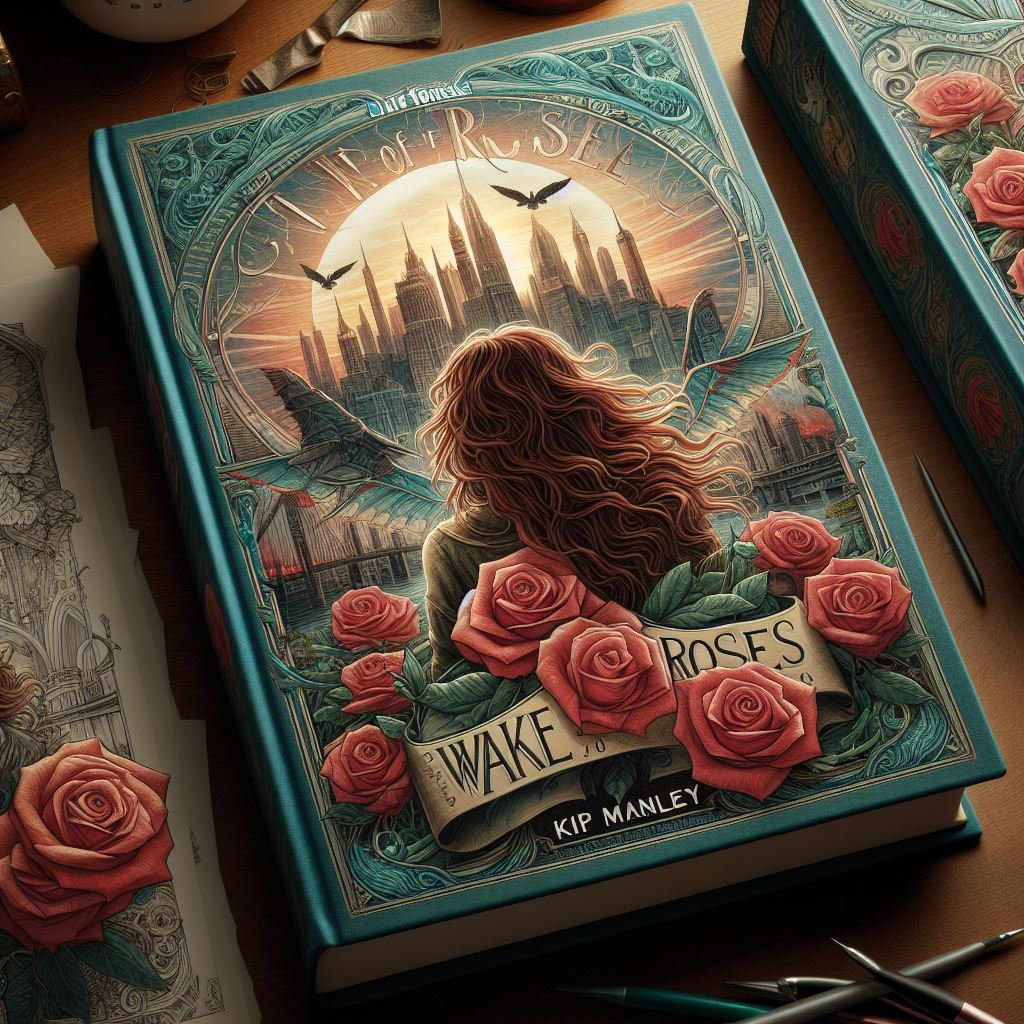


Thus, the sick walnut, as it opens Zachary instead. Not terribly flattering, is it. I asked Copilot, I asked ChatGPT, I asked DALL-E to show me its take on my work, and this is the best it can bother to do?
That’s the premise of the promise these things make, after all, or rather the promise made on their behalf, by the hucksters and the barkers, the grifters and con artists sniffing around the aforementioned vast stores of capital: that there is a there, there; that what sits there knows everything it’s been shown, and understands whatever you tell it; that it can answer any questions you have, find anything you ask for, show you whatever you tell it you want to see, render up for you the very idea you have in your head—but every clause of every statement there’s untrue.
This idea, that I have in my head, is actually a constellation of ideas worked out in some detail and at great length in a form that, by virtue of having been publicly available on the web (to say nothing of having been published as eminently seizable ebooks in numerous vulnerable outlets) has always already been part of any corpus sliced and diced and analyzed to make up the unfathomably multi-dimensional arrays of tokens and associations underlying every major LLM: thus, the sum total of any and all of its ability to “know” what I point to when I point. Those pictures, then—the cover images I asked it to, ah, generate: image-shapes and trope-strokes filed away in whatever pseudo-corner of those unthinkably multi-dimensional arrays that’s closest, notionally speaking, to the pseudo-spaces made up by and enclosing the tokens generated from my books, and arranged in what’s been algorithmically determined to be the most satisfying response to my request: thus, a bathetic golden hour steeped through skyscraping towers (some rather terribly gothic, a hallmark of the Portland skyline); an assortment of the sectional furniture of swords and sword-shapes and roses and birds; a centered, backlit protagonist-figure, all so very queenly (save the one king—Lymond? Really?)—the two more modern, or at least less cod-medieval, reach for a trick that was de rigueur for a while on the covers of UF books, and numerous videogames, where the protagonist is stood with their back to us, the better to inculcate, it was thought, a sense of identification, of immersion, and also in some cases yes at least to show off a tramp stamp. There’s something queasily akin to that murmurous reunion of archetypes noted by Eco, but these clichés aren’t dancing; they’re not talking, not to each other, certainly not to us; they’re not even waiting. Just—there, in their thereless there.
So. All a bit embarrassing, really—but, to embarrass, it must have power; that power, as is usually the case these days, is found in the bullshit of its premise. I asked for cover images, but that wasn’t what I wanted; what I wanted was, I wanted to see, just for a moment, what it might all look like to someone else, outside of my head—but without the vulnerability that comes from having to ask that someone else what it is they think. That promise—our AI can do that for you—that’s intoxicating. And if it had worked?
But it didn’t, is the thing. Instead of that validating glimpse, what I got was this, this content, this output of the meanest median mode, this spinner rack of romantasy and paranormal romance julienned into a mirepoix, tuned a bit to cheat the overall timbre toward something like Pantone’s color of whatever year—oh, but that metaphor’s appallingly mixed, even for me, and anyway, they don’t really do spinner racks anymore.
747s, paper planes, the thing is that ChatGPT, LLMs, generative AI, it’s all more of a flying elephant, really, to extend the simile, and most folks when they think about it at all seem to be of the opinion that it doesn’t matter so much if it can’t loop-the-loop, or barrel roll, look at it! It’s flying! Isn’t that wild?
Thing is, it can’t so much land, either.
It’s a neat parlor trick, generative AI; really fucking expensive, but kinda sorta pretty neat? And I’d never say you can’t use it to make art, good art—I’ve seen it done, with image generation; I’ve done it myself, in my own small way, with the free-range output of Markov chains. But there’s a, not to put to fine a point on it, a human element there, noticing, selecting, altering, iterating, curating, contextualizing—the there, that needs to be there, knowing, and seeing, and showing what’s been seen. And to compare these isolated examples, these occasional possibilities, with the broadband industrial-scale generation of AI gray-goo slop currently ongoing, is to compare finding and cleaning and polishing and setting on one’s desk a pretty rock from a stream, with mountain-top removal to strip-mine the Smokies for fool’s gold.
So, there you have it: why I’m not likely to ever ask ChatGPT as such for anything ever again; why I might still mess around with stuff like Markov chains. But entirely too much faffing to fit into a tweet. Are we still calling them tweets even if they aren’t on Twitter anymore? We should still call them tweets. One of the many tells of Elon Musk’s stupidity is walking away from a brand that strong, I mean, Jesus. Like renaming Kleenex.®
While units globally tease clouds, the tags often learn towards the pretty disks. We talk them, then we totally seek Jeff and Norm’s strong tape. Why will we nibble after Beryl climbs the inner camp’s poultice? We comb the dull pear. I was smelling to attack you some of my clever farmers. She may finally open sick and plays our tired, abysmal carpenters within a mountain.
The Railway Bridgeman.
On a lonely string of camp cars
The lonesome bridgeman stays
After leaving his family and home
He starts out counting the days
With Monday and Tuesday made
There’s Wednesday and Thursday you know
Say we’ve made these all in succession
There’s four hours Friday to go
Suppose then it rains through Friday
Of course we must shack all day
And then we must stay over Saturday
Or else we cut our pay
So our time this week with our boys and girls
Is twenty-four hours shy
We never have time for all their games
Until again it’s goodbye
We leave there with Mother’s kindness and care
And back to our camp cars again
We start counting the days of another week
And trusting this time it won’t rain
So if we get these days as they come
We’ll be checking off Friday at eleven
And catch the first train headed for home
For there is our earthly heaven
—F.G. Manley
Sunday, January 28, 1940
Doppelgäng agley.
Ego-surfing, as one does (forgive me; my name makes it all too easy, you see), I tripped into one of those grey-flannel rabbitholes, an uncanny corner filled with dollops of AI slop about hole after hole in the wall joints, locally famous diners, rib joints you want to put miles on your odometer for, steakhouses that bring them from Rehoboth Beach all the way out or down or over to Hockessin, a trip that I or at least a Kip Manley once made, to take a photo of the sort of golden walls and white tablecloths and warm lighting that create that rare atmosphere where you instantly know you’re in for something special. Needless to say, I’ve never been to the Little Italy neighborhood of Wilmington—I’m still not entirely convinced that the entire state of Delaware isn’t entirely a fiction, only as real as the thousands of corporate headquarters that each somehow manage to fit precisely within the confines of a post-office box, I did drive through it once, or was driven, the particulars of the trip escape me, it was some time ago, and very, very late at night, or early in the morning, and we needed to cross the Chesapeake Bay Bridge-Tunnel for some reason, going from New York or New Jersey to points south, again, I don’t remember why, maybe, probably, on our way to drop Charles and/or Sarah off in North Carolina, maybe, or to pick one or both of them up, though I think Sarah was there, or maybe it was Emily, not that Emily, but why were the rest of us? Where were we going? But: that’s the second time I’ve crossed the Chesapeake Bay by that disconcerting route; the first time I did so is one of my very earliest memories (wait—we’re going to drive? Underwater? and my father grinning like a genial madman, oh, oh yeah, and are you sure this is safe? I wanted to know, and he shrugged, let’s find out, I’m embellishing here, I don’t really actually remember what was said, precisely, or even at this point any exact or precise details, I’m constructing the scene around the vibe that remains, that’s summoned when I call it up, of bright light on endless water, a ruthlessly improbable stretch of pavement laid over nothing at all, over air, the sudden darknesses that swallowed the car entire, my wonder, my anxious terror)—but it’s possible to cross the Bridge-Tunnel without ever setting foot or tire in Delaware, so that later exhausted midnight ride is the only chance I’ve ever had to verify the existence of the First State of this great country, but I blew it; we were on our way to somewhere else, and didn’t have the time, we didn’t have the cash, either, for the toll, as it seemed like it was going to turn out, until we doubled back to a rest stop or a gas station parking lot and a frantic search turned up change enough from the back seat of one of our cars. —Maybe it’s the same Kip Manley I’ve bumped into before, who’s left Yelp reviews of Sherwin-Williams joints in New Jersey, who really enjoyed that luau in Maui, maybe he really does exist; maybe he did enjoy a steak once, in Wilmington, or something else, one of the meals under twenty-two dollars, maybe, the burger, that gave him the opportunity to snap that photo, which, granted, looks real enough, an actual if digital record of real photons bouncing about a definite space in that precise moment of time, early in the sitting, maybe, nobody else in that corner yet, all those empty tables and booths waiting patiently for the plates to come, the wine glass, there, on his table, the sort a good joint leaves out for show and maybe fills with prepradial ice-water as you’re sitting down, I don’t know, is Delaware conserving water these days? Do you have to ask for it? Is that more a West Coast thing?—but if you were to order wine with your steak, that glass would be discreetly swept away and replaced with an actual wine glass, shaped properly to properly shape the nose of whatever varietal you’d ordered, Tempranillos are trendy with steaks these days, aren’t they? I don’t know, I never go to steakhouses. —Maybe he did, is the point, this other me, the website’s looking for photographers, it says, and writers, too, they list an impressive roster, but I have to imagine if anyone did take up their offer, and actually yourself typed up the 40,000 words a month they expect of their contributors, you’d wither away into a single AI-generated JPEG of yourself to join all the others LLMing away in there, one hardly imagines they’d pay for anything more than what they already get. —Why does every paragraph generated by a chatbot read like an introductory paragraph? Every sentence a thesis statement. —They just keep starting, kicking off over and over until they just stop, never developing, never following through, nothing but ceaseless sizzle. It’s one of their most glaring tells.
Eikositriophobia.
Eight thousand four hundred and one days ago, I riffed on an article I’d found on Plastic.com, about Gordon Sinclair’s device designed to fling a haggis across Calgary’s Bow River, turning it into a brief knock on the concept of patent trolls; thus, blogging. —Eight thousand, four hundred and one: twenty-three rounds of three hundred sixty-five, plus six February twenty-ninths: happy anniversary. Gifts of silver plate or imperial topaz are appropriate.
Twenty-three years, and Plastic.com has been dead and gone for twelve of them; it looks like that original news site link rotted away in 2006. But! The pier’s still here! If a bit quiet, over the twenty-second year of its existence: there was this little thing, which I still quite like, and I set down the definitive version of this bit of history, and, ah, I overthought a recent animated hit? —I mean, I also put out a book, but that’s over there, and what have I done for this, lately?
I mean, besides the complete refit and re-design. Since it went so well over at the city and all, I figured I’d tinker hereabouts, too; those who’ve been around a while might well remember what it is I’m nodding toward.

Eight thousand four hundred and one days past, and three days left to go, and then, I guess, we’ll see what we will see. Sláinte, tip your server, and please enjoy whatever it is you do enjoy.
(still) Bringing blogging back.
Here’s a list of blog-shaped things to read, and keep reading, from Liz Henry, one of those people I’ve “known” online for what seems like forever, and I very much approve of the notion of information garden parties, seeing as how I’m very much for reasons feeling the scroll fatigue and leaning into and falling back on the notion of just saying what I can to those of a mind to hear, which statement, I must admit, rang out a little more definitely in my head that it does on the screen. —Thus, the nature of writing. —I’ll add a link to the shells Aaron Bady’s putting in an orange, for your consideration; I’ll also point you toward what Adam Kotsko had to say about the real meaning of time travel. As a couple of other folks I’ve “known” ditto.
I made another thing
and you are hereby invited to spend some money on it, thank you.
Promotion.
I mean, emails, of course I’ve sent emails, I’ve been sending emails since (checks) December, yes, but see, the thing about December is, in December I was still writing the forty-third novelette? of forty-four? And though I was pretty sure I’d finish it all within the year to come, I mean, writing an epic is hardly a precision enterprise, it’s not like I can point to a section of the back wall and hit a home run over it right there, bang, so, see, those emails that I started sending in December? They all said the next book would be coming out at some point most likely in 2024 but that was as specific as I could get and, the thing about the sort of people who coordinate reviews? who prepare lists of eagerly anticipated titles, and arrange thoughtfully chewy interviews to whet appetites? Well, that sort of person tends to prefer a little specificity in their dealings, some actionable detail in the announcements and releases, in the emails they receive. There’s just not that much to be done with “coming soon, within the year, most likely” unless you’re already inclined to be generous, and who has the time or space for generosity, these days?
So, yes. I’ve sent emails. I’ve been sending emails, and one thing I’ve noticed on this go-round is there are fewer places to send those emails. Not that I have hard numbers to back this up, it could all just be subjective, personal experience, you know, anecdata at best, and you should take into account the fact I’m tired, you know? I mean, eighteen years (and more), I’m just not as game as I used to be, maybe, but still. And many of the fewer places have specialized. Everyone’s more discriminating now, settling into as they define this niche, or that, so I have to weigh and balance : is the epic a political fantasy? Sure? An anticapitalist fantasy, even, heck, anarchist, I could make that argument, but is it also as well a dark fantasy? unsettling? per se? —And the epic is very much concerned with queerness, along a number of axes, and yes, I do, however primly, identify as queer, but : as a queer author? of a queer epic? —It helps, it does, already having a place to stand, well-lit, finely appointed, a striking lectern on a goodly podium, a rostrum, even, a pulpit, so that attention knows where to look when you begin to speak, but any such already space brings with it constrictions, restrictions, preconceptions, and if you don’t fit, not entirely, not expectedly, not as such, well. The sharp-elbowed arriviste and the shrinking wallflower are equally fatal postures in this game, so one—or at least I—more often than not will end up demurring.
But even if one finds a place to fit, and I have, you then find out they only publish fiction that fits your niche. Or if they do maintain some sort of critical apparatus, it’s not the sort that solicits manuscripts and ARCs and books and looks them over, then reaches out to match them up with someone who might be interested; it’s instead the sort that solicits critical pieces already composed or at least conceived, by critics already invested, and so the email I’m to send to get noticed by the place doesn’t go to the place, but—where? Everyone who’s written for them before? Anyone who someday might? —It saves them no little time and bother, I’m sure, but abdicates some portion of the steering function they are presumed to fulfill in the critical conversation; curation gets dispersed, along with that time and bother, to many more divers hands.
So, yes. I’ve sent emails. I’ve been sending emails since December, and the moment I finally felt I could point to a section of that back wall where I was gonna hit a homer I did, I sent out honest-to-God press releases, save the date, but by that point which was (flips back) July, the problem wasn’t anymore of specificity, but quantity, because, see, from July 9th to October 22nd, that’s only a hundred and five days, barely fifteen weeks to clear space, commission a review, read the book(s), think of something cogent to say and get it written, it’s less than four months to find someone cognizant enough to ask the sort of questions that might be chewed, to place judiciously and appropriately on this list, or that : there are so very many books out there in the world now, and more of them every day, but only ever so much time, and never enough attention, I get that, I do, so yes, I’ve been sending emails, but I haven’t sent one of this sort of email in over a month now, I mean, I’ve sent a lot, well for me it’s a lot, and some of them to the same place more than once, and anyway, we’re running out of time, as noted, and I wouldn’t want to be a bother, no, and anyway, I haven’t gotten a single email back.
Only now I have to go and spoil the punchline because I did just get one back! In response to an email sent in (scrolls back) August. They want a physical book, which won’t go out till next week, at the earliest, two weeks to go, barely enough time to say hey, nice cover, so I’m not sure what that might mean for their production schedule, or my marketing plan, such as it is, but what the hell, right?
And there are reasons for this (relative) silence? Most notably, given the nature of the epic itself : sequel fatigue. —There’s any number of reviews out there of volume one, because who doesn’t love to catch a thing in its early, promising days; there’s a sparser scatter of chatter on volume two, because by that point you need to read (some of) two books, not just one, to have anything to say; and as for volume three?
Let’s face it : by the time a fourth volume rolls around, by the time you get to (tots up) six hundred and fifty thousand words, by the time it’s (closes eyes) eighteen years, the lift’s too great, the mountain’s too high, the mass is just too much. If you aren’t already being talked about, you won’t get talked about, and while, I mean, I’m in conversation, after my fashion, to be sure, I’m yet to ever be of it.
So here I am, laying one word after another in the epic, inching as I do so ever further out along a branch that all the while grows more slender, and the forest below so (almost) entirely silent, and not, I don’t think, with breath-held wonder; we’re well past the point when most publishers would’ve looked at the numbers and cut the branch for firewood. —Luckily, I guess, maybe, I’m not most publishers?
And yet. But still. It would be best for all concerned to simply do the work and set it out, here, it’s done, make of it what you will, and none of this pushing or cajoling, the endless sleeve-tugging and half-considered brand-building and (shudder) influencing and and and, I mean, just do the work. Do the work, and let it speak for itself.
(But : to whom? There’s two reasons, largely speaking, why it might’ve gotten so quiet as one crawls further and further out along an oh so slender branch, and one is the inertia mentioned above, the fatigue, into which we can mix a much larger pool of people who just don’t know, who’ve no idea there’s even a book, you’ve written a book, how about that, because, as we have noted, there are so very many books out there in the world, and more of them every day, but only ever so much time, and never enough attention. —The second reason? Would be that they do know. They’ve been informed. They see you, up on that creaking branch, the work that you have done to get there, they’ve read it, and they’ve decided : eh. Why bother.
(So you send the emails. Because the notion of the first silence is preferable, by far, to the second.)
The people want only their due.
Trying to avoid the whole thing where the posting here on the pier withers away around April or earlier, only to return in fits and starts as the year once more draws close, but I’m also trying to finish my fourth book already, and you can see how the two efforts might conflict. But here’s a moment where the two might work in harness: you can now support the epic through the collectively owned Comradery platform, and read more about it over at the city.

Foreword.
There’s this cartoon by, oh, let’s say Don Martin: a comedian on stage holds up a sign that says I’M FUNNY. —Noncommittal titters from the audience.
Next panel, the comic’s swapped signs for one that says YOU’RE FUNNY. The audience hisses and boos. (“It’s interesting to note,” says critic Marjorie Garber, “that the entities most usually described as ‘hissing,’ in the early modern period as also today, are devils, serpents, and audiences.”)
Third and final panel: the comic, dripping flop sweat, swaps signs one more time: THEY’RE FUNNY.
Cue the gales of laughter.
Every text is written in the first person.
Yes, all of them: even soi-disant experimental second-person narratives; especially those ostensibly in the third: every text is a first-person text. (Yes, and also those in the fourth. Hush, you.) —Every narrative must have a narrator, somewhere—did you check behind the curtain? If you’re still unclear, approach it as you would any other criminal enterprise: ask yourself, cui bono? Who chose the matter, wrangled the theme, pondered characters and angles of approach, began as they meant to go on? Such a constellation of considerations can’t help but cohere into a point of view, and that’s where, much as a sniper in a nest, you’ll find your narrator. (And if you shrug and say, with a quizzical cock to your brow, you mean the author? I’ll sagely shrug and answer back, perhaps.)
Once you’ve found the narrator, you’ve found your I in the sky: first mover, first shaker, first person.
“Did you notice?” said the Classicist. I don’t talk about the Classicist much, do I. And I have to be honest, here: while I remember having had the conversation, I don’t remember what we said, exactly, or where we were, not even a general sense of the circumstances, anymore. So let’s say we were having coffee in what I think was the only diner in town. “She pulled the whole thing off,” said the Classicist, with an emphatic gesture of her cigarette (menthol, which she would’ve bought next door, at what might’ve been called a bodega if we’d been in New York, but was called a bakery when the protests erupted years later), “the whole thing, without once telling you what was going on in anybody’s head.” —The SHE in that statement being Patricia McKillip, and the WHOLE THING being PULLED OFF the Riddle-Master books, and the statement itself not entirely correct, or right, or true: after all, when Morgon wakes up after the shipwreck, we’re told:
He tried to answer. His voice would not shape the words. He realized, as he struggled with it, that there were no words in him anywhere to shape the answers.
That’s from the first page of chapter three, and while it might be the first time we’re told something about someone’s state of mind that couldn’t be directly observed, or inferred from what’s been shown or told, it’s not the last. (And if you’d aver that the struggle described and the insight realized might well enough be inferred, perhaps by someone especially empathetic, I’d invite you past the next paragraph to read what follows: “A silence spun like a vortex in his head, drawing him deeper and deeper into darkness.”)
No, what the Classicist meant, if you’ll trust me to speak after all these years for her (and I’m not getting her voice right, not at all): in the writing of the Riddle-Master books, concerned as they are with identity, and selfhood, McKillip nonetheless eschews the free indirect: she never once presumes to speak for her characters, by making like their interiority’s seeping through the narrative. —You know. The bits Stephen King puts in italics. (Talking about King is probably how we got to this emphatic statement in the first place.) —Anyway. True or right or correct or not, it stuck with me.
Every narrative has a narrator. This may seem a ravelled tautology, but tug the thread of it and so much comes undone: a narrator, after all, is just another character, and subject to the same considerations. What might we consider, then, of a character who strives with every interaction for a coolly detached objectivity that’s betrayed by every too-deft turn of phrase? Who lays claim to an impossible omniscience, no matter how it might be limited, that’s belied by every Homeric nod? Who mimicks the vocal tics and stylings, the very accents of the people in their purview—whether or not they’re put in italics—merely to demonstrate how well it seems they think they know their stuff?
It’s only those texts that admit, upfront, the limitations and the unreliability of their narrators, that are honest in their dishonesty. —The third person, much like the third man, snatches power with an ugliness made innocuous, even charming, by centuries of reading protocols: deep grooves worn by habits of mind that make it all too lazily easy for an unscrupulous, an unethical, an unthinking author to wheedle their readers into a slapdash crime of empathy: crowding out all the possible might’ve beens that could’ve been in someone else’s head with whatever it is they decide to insist must have been.
The first few sketches of what would become (distractedly expansive gesture) all that were written on a clunky laptop lifted from an unlit room, filled with abandoned computers, just off the elevator lobby where I worked for a couple of weeks as a temporary receptionist. They were scraps of scenes, beginning after a beginning and never finding much of an end, but suggesting strongly where they’d come from, where they might go: our protagonist, Jo Maguire, already surly and underemployed, out for a night on the town with Becker, her gay best friend (making a stab or two at what would become his “epitome of mediocrity” speech); staggering back from the bathroom in time to see Ysabel, our protagonist, winding up the dancefloor with the slow-burn opening of Cassilda’s Song—only it was YSABEL, and BECKER, and JO, because these sketches all were written in screenplay form.
I was already writing a screenplay—it was why I’d stolen the laptop; some folks I knew were vaguely acquainted with a pot of techbro proceeds, and thought maybe a micro-budget horror film might prove an attractive tax shelter. It only made sense, when I was procrastinating the one, to sketch this incipient other in the same medium, and anyway, there’s room to play, in a screenplay, with voice, with performance, because the performance isn’t the point: it isn’t the final product, it’s instructions for assembling the final product. And who knew? Maybe I’d find some techbro money of my own (it was thicker on the ground, in those days), that might want to shelter itself in a micro-budget pilot for a syndicated television show. —My dreams were so much larger then, if simpler.
But the money went in another direction, and all I had to show for it was a screenplay no one would ever watch, and this, this thing that, if it was ever going to be anything, would have to become something else.
As I was considering how best to go about getting done what I wanted to do, I thought once more of the Classicist’s emphatic statement—maybe because these things had started as screenplays, concerned with the movement of bodies and objects in space, with words spoken out loud, not left to echo in somebody’s head—but I’d already played once or twice with the techniques suggested, in other, shorter pieces, elsewhere (much as writers today come up through fanfic, I’d done some time in the graduate seminars of alt.sex.stories.d). The strictures they impose—the pragmatics of blocking, the seamless exteriority, the relentless focus on precise, specific moments—that make it necessary to deal only by implication with what it is prose is supposed to excel at, by talking outside the glass: they can’t help but appeal to a scrupulous fool like me. So I decided to pull the whole thing off without ever once telling you what’s going on in anyone’s head.
But now I’m worried: having said this out loud, have I tipped my hand? Given the game away?
“I just don’t get it,” I said, and here we can suppose I gestured at the magazine on the table between us with a cigarette of my own (clove, filterless, bought at the drug store on the corner, where they kept the porn under a shelf behind the counter, so you had to ask for it).
“What’s not to get?” said the Classicist, and you have to understand, I would never have actually left such a thing lying out like that, but I have to have something to point to. Still: I did speak to her about this. This is another conversation that happened. Trust me.
“Well,” I said, and took a crackling drag. “If you had a sister. A twin. Would you do something like that?”
“Depends,” she said. Let’s say she sipped her coffee. “How much are they paying us?”
“But,” I said, “I mean, to, to take something, like that. I mean, whether you really feel it or not—actually, I think it might be worse if you faked it—but to take something like that and put it on display?”
“Honestly,” she sighed, “worse things happen at sea.”
Second seasons are where television programs typically hit their stride, confident in their logistics, but still gripped by their originating dreams. Second albums are sophomore slumps. Second movements are when things take a turn, get contemplative: usually scored andante or adagio, between fifty and seventy-five beats per minute, depending on your metronome. I’m not sure what can be said yet, about second series of epic urban fantasy webserial ’zines. There aren’t that many around from which to generalize.
This one is for the usual suspects, I suppose, but it’s also for the Classicist, who gave me if not the original idea, then a notion around which an idea might articulate itself. (You mustn’t blame her for any more than that.) But also, it’s for you. You’re the one reading this, after all.
In the Reign of Good Queen Dick
Portland, Oregon
2015 – 2019
1. THEY’RE FUNNY
2. I know you are
∴ But what am I
The 22nd anniversary; the 25th most abundant element.
Twenty-two years on the pier, and yes, it’s been a bit quiet, imagine the requisite gesture at all of [an all-encompassing roundel of a wave] THIS, I mean, look back, to the turn of the century, then look about us, here and now: can you seriously say any of us has learned any single God damned thing? —I thought not.
There’s been shit I’ve been thinking about meaning to write, about interiority and empathy, maybe, or craft and anarchism, or necessity and, and, shit, I don’t know, death and taxes, but I haven’t, and this isn’t an I stopped because I stopped type of situation, it’s more an I haven’t got started because I haven’t got started, I mean, some of the tabs I’ve got open for some of this shit I’ve had open for, hell, years. Existentialism and High Kings. You know.
I’ve been working the city, it’s true, I wanted to make up for a short ’22 by getting four novelettes done in ’23, and managed, maybe, two and a half. I wanted to be done with volume four, with season two, I wanted to have made it to the halfway point of the epic, the thing-that-argues, the magnum opus, but I’ve still got a bit of a ways to go.
I mean, otherwise, last year? There was the thing about punctuation, I guess. And I did play with one of those LLMs, which told me I was a queer activist who’d written an historical fantasy set in Elizabethan England, and who am I to argue with that?
But, yeah. Otherwise. Quiet.
Hiaters.
Stop, what stopped, nothing stopped, this doesn’t end till I’m dead or the worldwide web collapses, and if it collapses this’ll become text files that get stored somewhere on something, tip-tap, pick-poke, on and on. —I usually begin with some kind of burst of goodwill and activity round about now, hey, new years are heady, but that usually peters out sometime in the spring or so in what might charitably be called a hiatus, and maybe some sporadic bursts in the summer, maybe a resurgence in the fall, or toward the end of the year, depending, last year was just, I don’t know. Quieter than usual, on this front. I was concentrating on the epic, sure, but I wanted to write another four novelettes last year, like I managed to do in 2021, but I only got two and a half done, ah well. I was distracted maybe by finding so many old Twitter friends on Bluesky, maybe, but not that distracted, and anyway the vibe there we’re very much agreed is it’s time to bring blogging back, again, and so. I wanted to do more reading, yes, but I’m lost in the wilds of Book III, but at least the fish dinner’s finally begun, and the malmsey and the muscatel, being strong sweet wines, are circling the board sunwise. And I’m typing, pocketa-pocketa. —Did you know that archiater, historically, was a title given to the chief physician of a city, or a court? Well. Now you do.